If your product ships in 20 markets and your demo video only exists in English, you're leaving a lot of the funnel cold. That's not a guess, it's basically confirmed by how buyers behave now: most B2B buyers say native-language product content changes how much they trust a vendor, and a meaningful chunk will drop off entirely if a video isn't in their language. For a global SaaS company, that's a real revenue problem hiding inside what looks like a content problem.
The old fix was booking a studio, hiring a voice actor per language, and re-shooting or re-recording everything. That's slow and it gets expensive fast. Neural voice cloning changes the math enough that it's worth understanding what's actually possible now, and where it still falls short.
What's actually happening under the hood
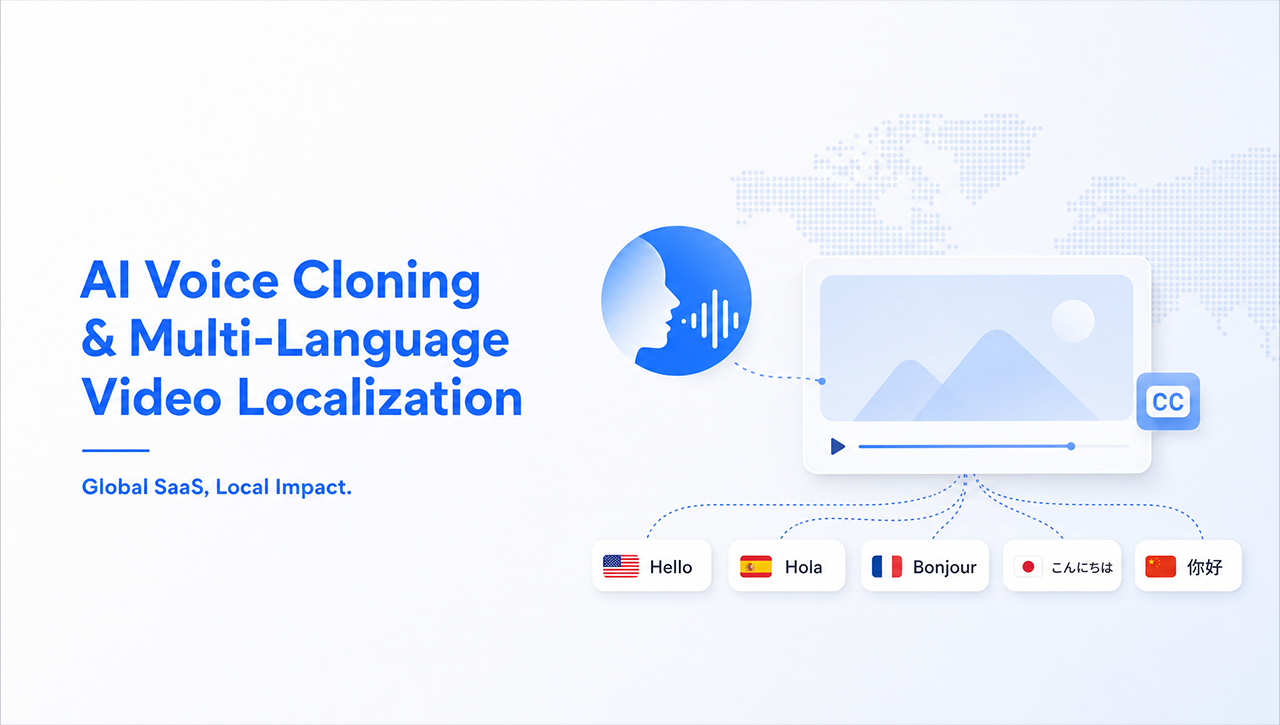
AI dubbing sounds like one feature but it's really a pipeline with a few distinct steps. First the original audio gets transcribed. Then that transcript gets translated, and the good tools do this with context-aware translation rather than word-for-word substitution, because word-for-word is where dubbing has always sounded robotic. Then the translated script gets turned into speech, either with a cloned version of your original speaker's voice or a synthetic voice built for that language. Finally, everything gets aligned back to the original video, either matched to the timing of the cuts or, on more advanced platforms, matched to the speaker's actual lip movements.
The part that used to be impossible and now genuinely works is the voice cloning step. Modern tools can clone a voice from a short sample, in some cases as little as 15 seconds of audio, and carry that person's tone, pacing, and delivery into a completely different language. Your presenter can sound like themselves in French, Japanese, and German, not like a generic text-to-speech voice reading a translated script.
What this actually costs and saves
Traditional studio dubbing has historically run somewhere in the $50 to $150 per minute range once you factor in a translator, a voice actor, and studio time, and that's per language. Multiply that across even a modest set of target markets and a single product video becomes a five-figure localization project before you've touched the visuals.
AI-driven localization brings that down dramatically, with most estimates putting the cost reduction somewhere around 80 to 90% compared to traditional dubbing. On the SaaS side specifically, teams localizing product videos this way have seen per-language costs drop from the $4,000 to $8,000 range down to something closer to a seat license fee, because the marginal cost of adding another language is mostly just processing time. And the accuracy on clear source audio is now high enough, often cited in the 90%+ range, that most of what you're checking in QA is naturalness and tone, not whether the translation is even correct.
Timeline shifts just as much. A launch video that used to take a quarter to localize into a dozen markets can realistically go out the same week, sometimes the same day.
Where it still needs a human in the loop
None of this means you can just upload a video and walk away. A few things still need real attention.
Consent and provenance. Cloning someone's voice, even your own team's, raises real questions about consent, and the more credible platforms now require explicit confirmation before cloning a named individual and embed some form of watermarking in the output. If your legal or compliance team hasn't been looped in on this, they should be before this becomes a standing part of your video workflow.
Lip-sync for on-camera footage. Voice-first tools are excellent for narration and voiceover, but if you've got someone talking to camera, a mismatched mouth movement undercuts the whole effect instantly. Not every dubbing tool handles this well, and it's worth testing specifically on your own footage before committing to one platform.
Tone and idiom, not just translation. Even the best neural translation can produce something technically correct but culturally flat, or occasionally wrong in tone for a specific market. Sarcasm, humor, and anything rapid-fire in the original script is still where these tools are weakest. A native speaker doing a pass on the script before it goes to voice synthesis catches problems a purely automated pipeline won't.
The practical shape of a good workflow
Shoot or generate your source video once, in your primary language, with the localization pipeline in mind from the start. That means avoiding on-screen text baked into the video itself, keeping cuts and pacing reasonably universal, and scripting in a way that translates cleanly rather than relying on wordplay that won't survive the jump to another language. From there, run the transcript through translation with a native reviewer pass, generate the cloned voice track per language, and check lip-sync and pacing before it ships.
Done this way, one English shoot genuinely can become 10, 20, or 30 market-ready videos without turning into 30 separate production projects. For a global SaaS team, that's not just a cost saving, it's the difference between treating international markets as an afterthought and actually meeting buyers in the language they trust.