If you've priced out a corporate video lately, you already know the sticker shock. And if you've also poked around at HeyGen or Synthesia, you've probably wondered if you even need a production company anymore. So let's actually break down the numbers, because "AI is cheaper" doesn't tell you much on its own.
What traditional production actually costs in 2026
Ask five production companies for a quote and you'll get five different numbers, and that's not agencies padding their rates, it's just that "video" isn't one thing. A single-camera talking head shot in an office is a very different job than a multi-location brand film with actors and custom motion graphics.
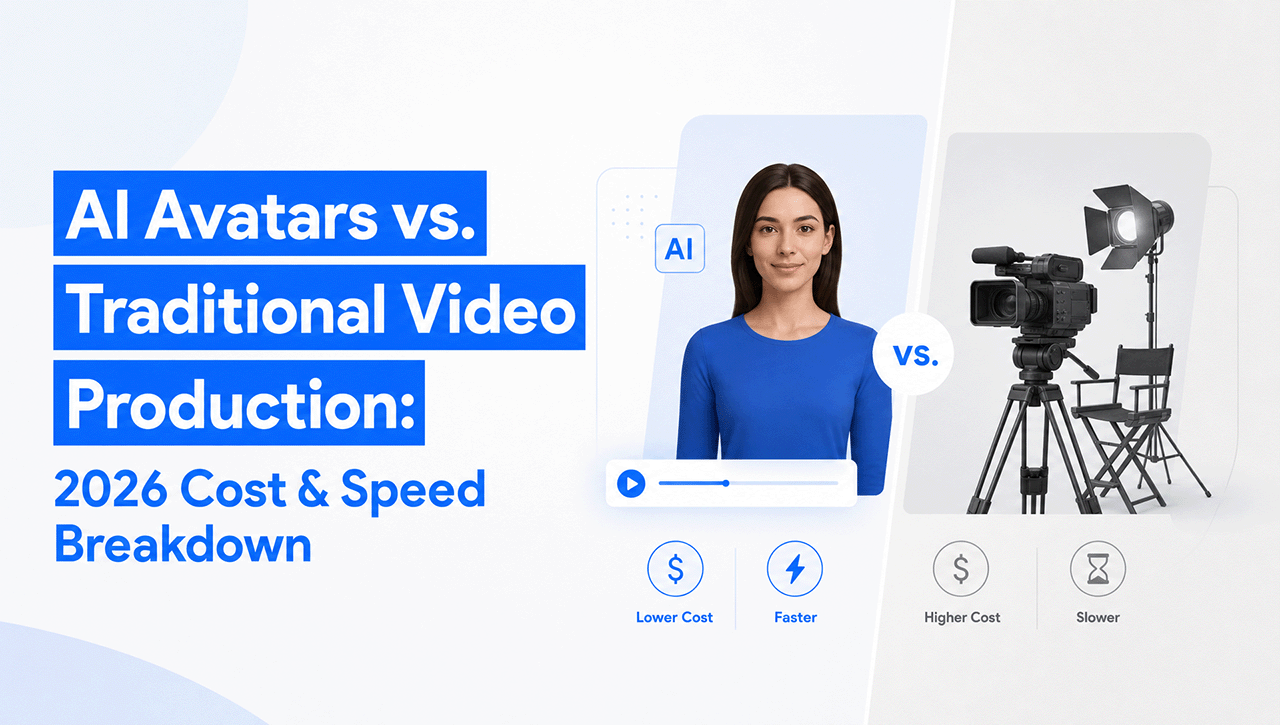
Rough numbers for 2026: a basic, low-frills video runs somewhere around $1,000 to $2,000 per finished minute. Professional-grade work with a real crew and proper post-production lands more like $3,000 to $5,000 a minute. And premium stuff, think custom animation, hired talent, cinema-level gear, can push $5,000 to $10,000+ per minute. A full agency project, start to finish, averages somewhere in the $40,000 range once you include pre-production, the actual shoot, and editing.
Then there's the timeline. Scripting, storyboarding, scheduling a crew, booking a location or studio, shooting, and then editing typically stretches into weeks, sometimes over a month for anything with real production value. That's before you even get to revisions.
What AI avatar tools actually cost in 2026
The AI avatar platforms (HeyGen, Synthesia, and similar tools) look cheap on the surface. Plans start around $20 to $30 a month. But the sticker price and the real cost aren't the same thing, especially once you're producing at any real volume.
Most of these platforms run on a credit system, and the highest-quality avatar output eats credits fast, sometimes 6 or 7 times faster than the standard tier. So a plan that looks like it covers "unlimited" video often only covers a handful of minutes at the quality level you'd actually want to publish. Teams regularly end up paying $100+ a month instead of the $29 they signed up for, just to hit their actual production volume. At the raw generative video API level (using something like Seedance 2.5, ByteDance's current-gen video model, rather than an avatar platform), pricing usually works out to somewhere around $0.09 to $0.23 per second depending on resolution, roughly $0.13 to $0.14 a second at standard quality. That's cheap for a single clip, but it adds up fast once you're producing dozens of shots a month instead of one or two, and it adds up faster than the sticker price suggests, because the first generation usually isn't the one you keep. Getting a shot that actually matches the brief (right motion, right framing, right consistency with the rest of the sequence) often takes a few attempts, and every attempt is billed the same as a keeper. Budget for re-rolls, not just finished shots.
Where AI avatars really win is speed. A video that takes weeks to shoot and edit traditionally can be generated in minutes once the script and avatar are ready. No crew to schedule, no studio to book, no waiting on a location. That part of the pitch is genuinely true.
Where the comparison gets more complicated
Here's the catch that doesn't show up in either platform's pricing page: AI avatar tools are priced and built for one specific kind of video, a person talking to camera. That's great for training content, internal comms, or a simple product explainer. It's not what most brands mean when they talk about a "campaign."
The moment you need something with actual cinematic direction (motion, b-roll, multiple shots that need to feel consistent, a story instead of a talking head) the AI avatar comparison stops being relevant, because that's not what those tools are for. And the moment you need volume, say a training video program with a real curriculum or a campaign across a dozen assets, the credit-based pricing on the avatar platforms starts adding up in a way that closes the cost gap with traditional production faster than people expect.
So which one actually makes sense
For a single, straightforward talking-head video, an AI avatar tool is genuinely hard to beat on both cost and speed. There's no real argument for booking a studio and a crew to film someone reading a script to camera when a platform can generate the same thing in an afternoon for a fraction of the cost.
For anything that needs to look and feel like a brand asset, something cinematic, something with a consistent visual identity across many shots, or something that needs real creative direction, the calculation flips. That's where a studio that knows how to actually direct generative AI models (not just an avatar platform, but the full range of video and audio generation tools) tends to land somewhere in between: faster and cheaper than a traditional shoot, but with the craft and consistency that a raw avatar tool was never built to deliver.
The honest takeaway is that "AI vs. traditional" is the wrong frame. The real question is what kind of video you're making, and matching the tool (or the team) to that job.