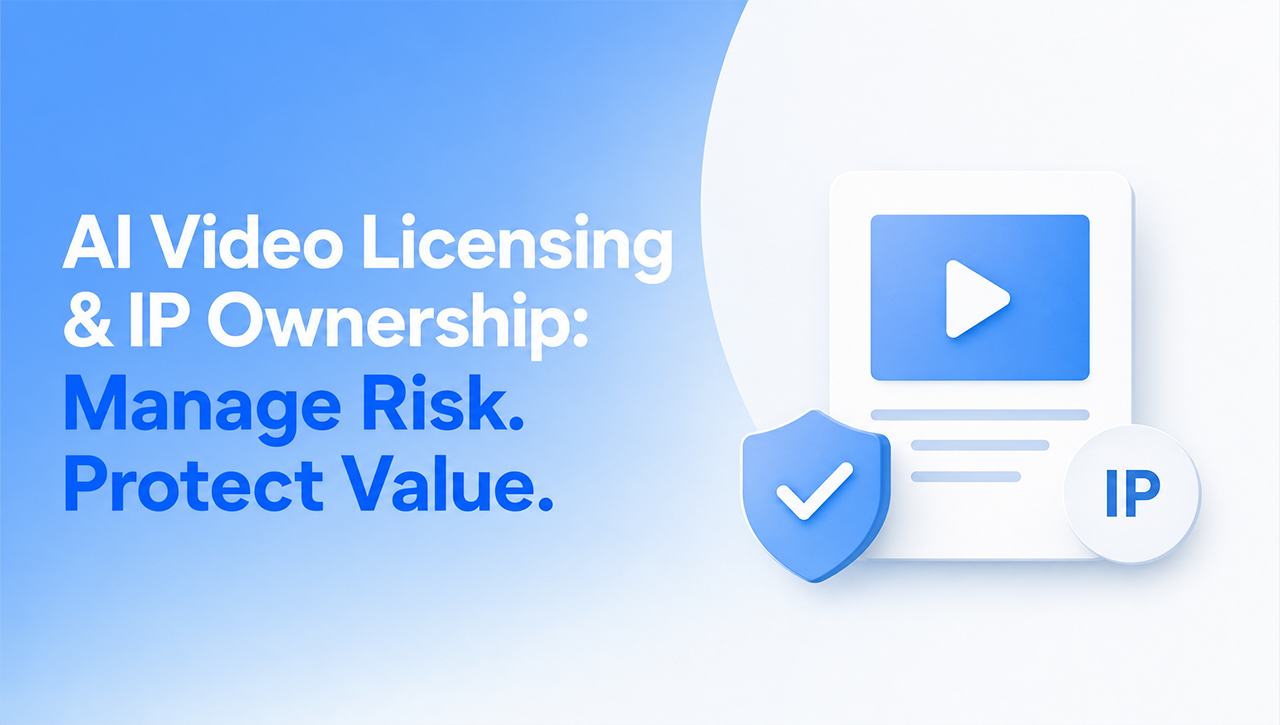
If your marketing or product team is producing video with AI tools, and by 2026 most are, there's a legal question sitting underneath all of it that a lot of executives haven't actually had answered: who owns this, and can you get sued over it? The honest answer right now is "it depends," and the details matter a lot more than most teams realize.
This isn't meant to be a scare piece. It's meant to be the version of this conversation your legal team wishes marketing had started six months ago.
The ownership question is genuinely unsettled, and one part just got clearer
In the US, copyright law has always required human authorship. That's not new. What's new in 2026 is that this got tested directly and the answer held: the Supreme Court declined to hear an appeal in a case where someone argued an AI system itself should be recognized as the author of a work, which left the lower court rulings in place. The practical result is that AI cannot hold copyright, and the US Copyright Office's position is that protection is reserved for work where a human made the meaningful creative choices.
What that means for your video: a piece generated entirely from a prompt, with no human scripting, editing, or arrangement, likely isn't protected by copyright at all. Nobody owns it, technically, not you and not a competitor who decides to reuse it. That's a very different risk profile than most teams assume when they hear "AI-generated," which they tend to treat as functionally the same as "we own this."
The fix is a documented human-in-the-loop workflow
The workaround isn't complicated, but it has to be real and it has to be documented. When a human makes meaningful creative decisions on top of the AI output (writing or editing the script, directing shot selection, doing the final edit, color grading, arranging the sequence) that human contribution is what creates a copyright claim. A raw, unedited AI clip published straight from the generator is the weakest position you can be in. The same clip, cut and arranged by an editor into a finished piece, is a much stronger one.
Practically, this means keeping a record of the human creative work that went into a piece: scripts, edit decisions, revision history. Not because it's bureaucratic theater, but because if ownership or infringement ever comes up, that record is what your legal team will actually need.
The other side of the risk: what's baked into the model
Ownership of your output is one question. Whether that output infringes on someone else's material is a separate one, and it's the one with active lawsuits attached to it. Several AI video and image companies are currently facing legal claims over what their models were trained on, and as of now none of those cases have produced a final ruling that pins liability on downstream commercial users. Risk to a company just using the tool appears low right now, but it isn't zero, and "no ruling yet" is not the same as "settled."
This is where vendor selection actually matters as a risk decision, not just a creative one. A few things worth checking before you standardize on a tool:
Training data provenance. Some platforms are moving toward disclosing what their models were trained on, or explicitly using licensed and cleared source material. That's a meaningfully lower-risk position than a closed model with no disclosure.
Indemnification. This is the single most useful line item in a vendor contract. Enterprise tiers from several major platforms now include copyright indemnification, meaning if you get sued over AI-generated output, the vendor covers the legal costs and damages. Free and lower tiers usually don't include this. For any brand-critical or high-visibility campaign, this should be treated as close to non-negotiable.
Commercial license terms, read literally. "Commercial use allowed" and "fully indemnified" are not the same sentence, and platforms vary a lot on this. Some grant commercial rights on every plan but only indemnify Enterprise customers. That gap is exactly where a company gets caught off guard.
Jurisdiction changes the picture
A license or legal position that holds up in the US doesn't automatically translate elsewhere. The EU has its own AI regulatory framework now, including specific disclosure requirements for certain higher-risk applications, which can catch targeted advertising depending on how it's built. If your company operates across US, EU, and Asian markets, a single blanket policy written for one jurisdiction isn't safe to apply everywhere. This is worth a direct conversation with counsel rather than an assumption.
Disclosure isn't optional
Separate from the ownership question, there's a straightforward honesty issue: if a client, partner, or buyer is licensing content from you, or if you're representing a video as fully your own work, not disclosing that AI was involved is a misrepresentation problem, not just an ethics one. It can expose you to liability that has nothing to do with copyright at all. The safe default is to disclose AI involvement and be specific about what the human creative contribution actually was.
What this looks like as a standing policy, not a one-time review
A few things worth putting in place rather than revisiting per project:
- Standardize on tools that offer enterprise indemnification for anything customer-facing or brand-critical, and treat that as a real budget line, not a nice-to-have.
- Require a documented human-in-the-loop step (scripting, editing, or direction) on every piece before it ships, and keep the record.
- Loop legal in on vendor selection, not just procurement and creative. The license terms are a risk document, not fine print.
- Build jurisdiction-specific review into any campaign running across US, EU, and other regulated markets.
- Default to disclosure. It's cheaper than the alternative.
None of this is a reason to slow down AI adoption. The economics are too good and the category isn't going away. It's a reason to treat the legal side with the same seriousness as the creative side, because right now the law is still catching up, and the companies that get burned tend to be the ones that assumed it already had.
This is a general overview, not legal advice. AI copyright law is genuinely still developing and moving quickly across jurisdictions, so any specific licensing or liability decision should go through your own legal counsel.