If you've looked at a retention graph in YouTube Studio or TikTok's analytics and seen a steep drop right at the start, you already know the problem. Most short-form video doesn't die because the content is bad. It dies in the first three seconds because nobody earned the next three.
That window isn't a soft guideline anymore, it's basically the whole game. TikTok has pointed out that a large majority of its highest-performing, highest-click-through videos hook viewers within the first three seconds. And once you understand why, it's obvious: completion rate is the main signal these platforms use to decide who else sees your video, and completion rate is set almost entirely by whether people are still there at second three. Brands that go back and rebuild their opening few seconds with intention regularly see CTR lifts in the 40 to 50% range, simply because more of the audience that would have swiped away now sticks around long enough to see the offer.
So what does a hook that actually works look like, and how does that change once AI is generating the shots?
Why most hooks fail before they even start
Watch enough retention curves and you'll notice the same shape over and over: a steep 30 to 50% drop somewhere between second one and second three, then a slow bleed after that. Almost every time, the cause is the same handful of mistakes. An intro card. A logo animation. A wide establishing shot before anything happens. A "hey guys" opener. All of that delays the one thing that actually earns a viewer, which is giving them a reason to stay before they've even finished deciding whether to scroll.
The fix isn't complicated, it's just unforgiving. Something has to happen, visually, in the first second. Not a setup for something happening. The thing itself.
The actual architecture
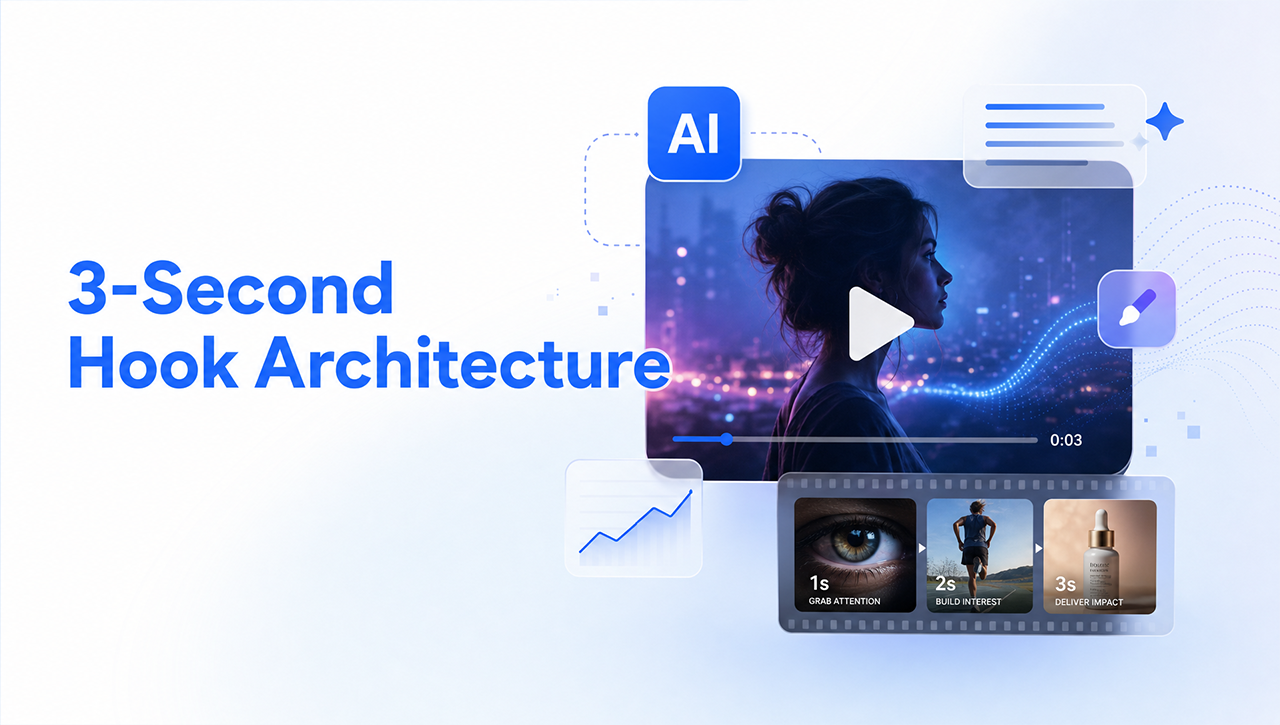
Think of the first three seconds as three separate jobs stacked on top of each other, not one long shot.
The pattern interrupt (0 to 1 second). A hard cut, a snap zoom, a whip pan, or a visual that doesn't match what the viewer expects to see next in their feed. This is what makes a thumb pause mid-scroll before the brain has even processed why.
The promise (1 to 2 seconds). Once you've got the pause, you need to justify it immediately. A bold claim, a visible tension, a question the viewer now needs answered. This can be spoken, but it should also be readable as a caption, because a huge share of this audience is watching with the sound off.
The stakes (2 to 3 seconds). This is where you either open a curiosity loop or show the beginning of a payoff. Either way, the viewer needs to feel like leaving now means missing something, not that they've already seen the whole idea.
Miss any one of those three jobs and the curve cliffs. Nail all three and you get what platforms call a hump or plateau curve, which is the shape that actually gets pushed to more people.
Where AI generation changes the equation
This is where AI shorts get interesting, and also where a lot of brands get sloppy. Generating video with something like Seedance or Kling means you can produce five or ten different hook variants for the price of what one traditional shoot would cost for a single opening shot. That's a real advantage, because the only reliable way to know which hook works is to test several against each other and read the retention curve, not to guess.
But it also means the discipline matters more, not less. A generated shot that looks great in isolation can still fail as a hook if the motion doesn't read in the first half-second, or if the framing doesn't leave room for a caption in the safe zone, or if the pacing between the interrupt and the promise is a beat too slow. Those are directing decisions, not prompting ones. The model gives you the raw shot. Someone still has to decide whether that shot actually does its job in the opening window, and cut it down until it does.
The practical takeaway
Treat your opening three seconds as its own separate production problem, not just the start of the video. Shot-list a handful of hook variants, keep the body of the video identical, and only vary what happens before second three. Caption everything for silent viewing. Cut the intro card, the logo, and the slow establishing shot, all of it. And if you're generating with AI, use the low cost per clip to actually test hooks against each other instead of shipping your first attempt, because the gap between a hook that works and one that doesn't is usually the single biggest lever on the whole video's performance.